By EMAN Future Trading Company · Electrical distribution guide
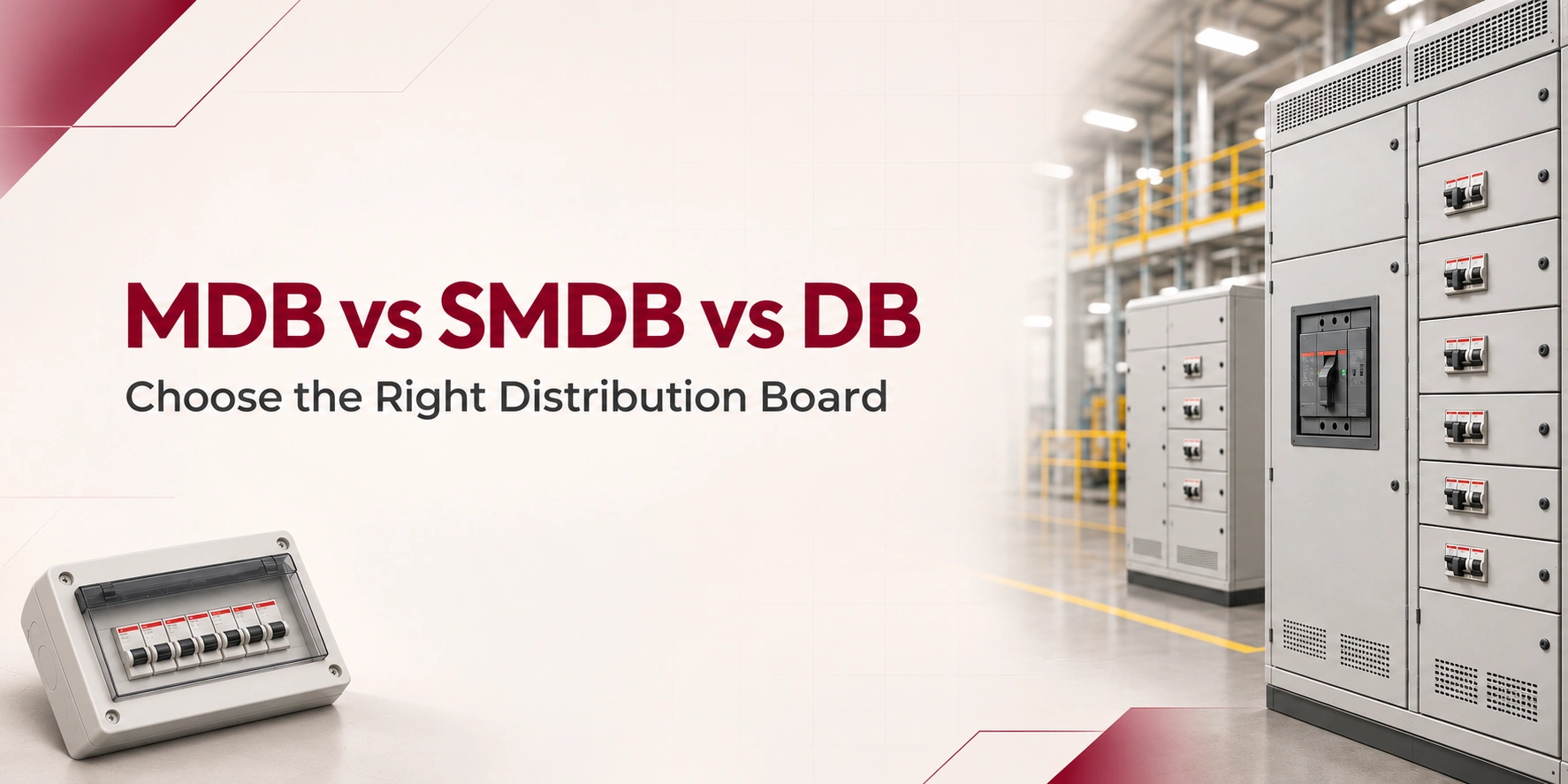
An MDB, an SMDB and a DB usually serve different levels of the same low-voltage electrical system. The MDB handles the main distribution, an SMDB serves an intermediate area or group of boards, and a final DB supplies the circuits used by equipment, lighting and sockets.
If you are preparing a BOQ, the choice starts with what each board will supply. A large building may use all three levels. A smaller installation may not need a separate SMDB at all.
Quick comparison: use the MDB for the main incoming distribution, an SMDB where the design needs an intermediate distribution point, and a final DB for outgoing final circuits.
A note on names: DB can also mean “distribution board” in a general sense. In this article, it means a final distribution board. Check the drawing legend and single-line diagram, rather than relying on the label alone.
MDB vs SMDB vs DB: The Main Differences
These names describe a board’s position and purpose within the installation. They do not, by themselves, specify its current rating, short-circuit capability, size or enclosure construction. The terminology below follows the main, intermediate and final distribution levels described in Schneider Electric’s installation guidance.[1][2]
| Board | Meaning and role | Typical outgoing supplies | Example location |
|---|---|---|---|
| MDB | Main Distribution Board; the main low-voltage distribution point. | SMDBs, final DBs or dedicated feeders to major loads, according to the design. | Main electrical room serving a building or facility. |
| SMDB | Sub-Main Distribution Board; an intermediate distribution point. | A group of downstream boards or area loads. | A floor, building wing, workshop or operational zone. |
| DB | Distribution Board; used here for a final-circuit board. | Final circuits for lighting, sockets and other suitable loads. | Near the rooms or area served by those circuits. |
This is a typical arrangement, not a requirement to include every board type. The approved single-line diagram defines the actual supply path.
What Does Each Distribution Board Do?
MDB — Main Distribution Board
The Starting Point for Main Low-Voltage Distribution
The MDB receives the installation’s incoming low-voltage supply through the specified supply arrangement and divides it into outgoing feeders. Those feeders may serve different buildings, production areas, downstream boards or large dedicated loads.
Start with the single-line diagram and load schedule. They establish what the board feeds and help the engineer define the incoming arrangement, feeder requirements and future allowance. “MDB” alone is not a complete purchasing specification.
Request main distribution board details or browse the power-distribution catalogue.
SMDB — Sub-Main Distribution Board
An Intermediate Point for an Area or Group of Loads
An SMDB takes an upstream supply and redistributes it within part of the installation. For example, it may serve several final DBs on a floor or within a separate warehouse area.
Whether that extra level is useful depends on the layout, load grouping, cable routes and operating needs. Adding an SMDB simply because a project is called “commercial” does not establish a sound design.
Request sub-main distribution board details using the feeder schedule for the area it will serve.
DB — Final Distribution Board
The Board Supplying Final Circuits
A final DB distributes its incoming supply into the circuits serving the local loads. An office DB might supply lighting, sockets and suitable small equipment through separate protected circuits.
Final DBs may have single-phase or three-phase supplies, depending on the system and loads. “DB” does not automatically mean single-phase, just as “MDB” does not define a particular current rating.
Request final distribution board details with the circuit schedule and supply information.
Which Arrangement Fits Your Project?
The following examples illustrate the selection questions. They are not completed-project claims or ready-to-install designs.
A Small Workshop
A compact workshop may have a main board feeding its final circuits or local DBs without a separate SMDB. The design still needs to account for motor loads, starting requirements and any dedicated machinery supplies.
A Multi-Floor Office
The main board may feed an SMDB for a floor or zone, which then supplies local final DBs. The project team would assess circuit grouping, cable routes and how parts of the building can be isolated for maintenance.
A Warehouse Expansion
A new storage area may need local distribution, while a conveyor or pumping system needs a dedicated feeder and its own controls. The existing upstream capacity must be checked before adding those supplies.
A distribution board and a motor-control panel do different jobs. If the project also needs starters, drives or programmed control, see our guide to electrical and automation control-panel types and control panel design and assembly service.
Six Checks Before You Order a Distribution Board
- Confirm the loads and incoming arrangement. Give the engineer the load schedule, supply details and information about equipment that will run together. A total connected-load figure alone does not describe the full operating demand.
- Establish the fault duty. Breaker selection must account for the prospective short-circuit current at the installation point, along with the electrical and environmental conditions. The assembly’s required short-circuit capability also needs to be specified. Current rating and fault rating describe different requirements.[3]
- Check protection coordination. The aim of selectivity is for the appropriate downstream device to clear a fault while keeping unaffected circuits supplied. A higher upstream ampere rating does not prove coordination; the devices, settings and manufacturer data need assessment.[4]
- Match the enclosure to its location. Temperature, dust, moisture, access, mounting space and cable entry affect the assembly choice. An indoor electrical room and an exposed service area do not necessarily need the same enclosure.[1]
- Review cable routes and connections. Provide cable sizes where designed, route information, entry direction and termination requirements. These affect installation space and the interfaces the supplier must provide. EMAN FTC also lists power cables and wiring products for related project needs.
- Define future capacity in useful terms. Identify the loads you expect to add, rather than asking only for spare ways. Empty outgoing positions do not establish that the incoming supply, busbars, protection or upstream installation can carry more load.
Compare the complete scope. Two quotations with the same “MDB” label may differ in feeder quantities, protection, enclosure construction, verification records and site work. Those differences matter more than the heading on the quotation.
What About IEC Standards and Saudi Project Requirements?
The IEC 61439 series addresses low-voltage switchgear and controlgear assemblies. Part 2 covers power switchgear and controlgear assemblies; Part 3 covers distribution boards intended to be operated by ordinary persons within its defined scope. The applicable part follows the assembly and application, rather than the MDB, SMDB or DB label alone.[5][6]
For Saudi building projects, the Saudi Electrical Code, SBC 401, addresses electrical-system design, installation and safety, including distribution panels and circuit breakers. Confirm the applicable code edition, authority requirements and consultant specification for your particular project.[7]
Ask the supplier to identify the assembly requirements and provide the specified supporting documents. A recognised brand of circuit breaker does not, by itself, verify the complete assembled board. Our electrical panel FAT and SAT guide explains how acceptance checks and handover records can be planned.
What to Send for an MDB, SMDB or DB Quotation
You do not need to guess every technical detail before making contact. Send the project information available and identify which items still need clarification.
- Single-line diagram, BOQ and board or circuit schedules.
- Project location and the board’s role in the installation.
- Supply details, connected loads and available fault-level information.
- Incoming and outgoing device requirements from the design.
- Installation environment, dimensions and cable-entry arrangement.
- Approved component brands, consultant requirements and required verification.
- Planned future loads, delivery date and any installation or commissioning scope.
Use the same information when comparing quotations. If one supplier has excluded site installation or testing, make that visible before comparing the totals.
For an existing installation, include current drawings, board identification details and the proposed changes. Our control panel troubleshooting and maintenance and automation upgrades and retrofitting pages describe related support for control equipment; tell us the actual distribution-board work required so the service scope can be confirmed.
Need Distribution Boards for a Saudi Project?
EMAN FTC lists MDBs, SMDBs, final DBs and circuit-protection products for industrial and commercial enquiries. Share your BOQ or single-line diagram with the team to discuss product requirements and availability.
Based in Riyadh, EMAN Future Trading Company supports projects across Saudi Arabia. Delivery and any additional technical scope are confirmed for the enquiry.
+966 58 339 5756info@emanftc.com
Technical References
This guide explains common terminology and purchasing considerations. Final ratings, protection and board arrangements should follow the project’s engineering design. The technical references below provide the underlying guidance and standard scopes.
- Schneider Electric Electrical Installation Guide: distribution switchboards.
- Schneider Electric Electrical Installation Guide: distribution architecture glossary.
- Schneider Electric Electrical Installation Guide: circuit-breaker selection.
- Schneider Electric Electrical Installation Guide: coordination between circuit-breakers.
- IEC 61439-2: power switchgear and controlgear assemblies.
- IEC 61439-3: distribution boards intended to be operated by ordinary persons.
- Saudi Building Code Center: Saudi Electrical Code, SBC 401.
Common Questions About MDB, SMDB and DB
What is the difference between MDB, SMDB and DB?
An MDB serves the main low-voltage distribution level, an SMDB provides an intermediate distribution point for an area or group of loads, and a final DB supplies outgoing final circuits. The single-line diagram defines their actual relationship in a project.
Does every building need an MDB, SMDB and DB?
No. The distribution arrangement depends on the loads, layout, cable routes and operating needs. A smaller installation may not require a separate SMDB. The approved design should establish the required boards.
Can an MDB feed a final DB directly?
Yes, where the engineered arrangement provides for it. An intermediate SMDB is not automatically required between every main board and final DB.
Is a DB always single-phase?
No. Final distribution boards can have single-phase or three-phase supplies, depending on the system and connected loads. The DB label does not define the phase arrangement.
Are there fixed current ratings for MDBs, SMDBs and DBs?
There is no single universal current range that defines all three names across projects. Select the ratings and assembly requirements from the engineering design, loads, fault conditions and applicable specifications.
Is an MCC the same as an SMDB?
No. An SMDB is an intermediate distribution board. An MCC groups motor feeders and associated control and protection equipment. A facility may need both, depending on the loads and control requirements.
Will a larger upstream breaker guarantee selectivity?
No. Selectivity depends on the protective devices, settings, fault conditions and manufacturer coordination data. A difference in ampere ratings alone is not evidence that the required coordination has been achieved.
Can I add circuits if the board has spare ways?
Spare ways provide positions for outgoing devices, but do not prove that the installation has spare electrical capacity. The incoming supply, assembly ratings, upstream equipment, load demand and protection need review before additional loads are accepted.
What should I include in a distribution-board enquiry?
Send the single-line diagram, BOQ, load and circuit schedules, project location, supply details, available fault information and installation conditions. Include the consultant specification, preferred components, delivery date and any site-work requirements.
Does EMAN FTC supply MDBs, SMDBs and DBs?
EMAN FTC lists main distribution boards, sub-main distribution boards and final distribution boards in its power-distribution catalogue. Contact the team with your specification to confirm a suitable product and current availability.