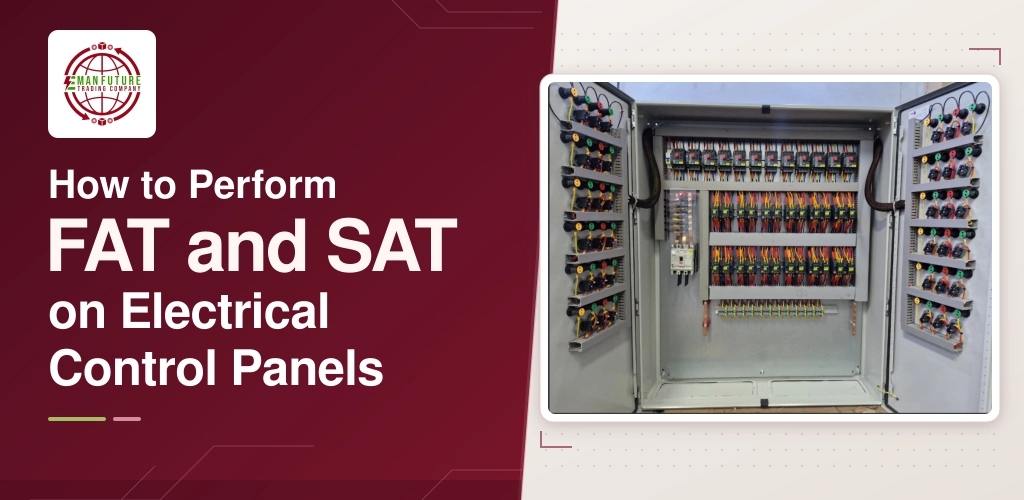
EMAN FTC / Electrical control panel acceptance testing
A fan starter can respond perfectly to a simulated signal at the factory. On site, the same starter may wait for a run permission that never reaches the panel.
Factory and site acceptance testing help you find those gaps before handover. This guide shows what to check at each stage, how to record a failed test, and what to ask for before accepting an MCC, PLC, or VFD panel.
What Are FAT and SAT for Electrical Control Panels?
Quick answer
Factory acceptance testing (FAT) checks an electrical control panel against agreed requirements before shipment. Site acceptance testing (SAT) verifies the installed panel and its interfaces using the actual site wiring, equipment, and control systems. Record the expected result, observed result, and any correction for each test.
FAT gives the buyer evidence to review before releasing the panel for shipment. SAT gives the site team evidence that it works in the installed system. The contract and approved test plan define the scope, sign-off authority, and criteria for each decision.
For a factory ventilation system or a hospital utility HVAC system, that difference matters. A workshop can simulate a remote permission signal, while the site test can prove that the installed building controls actually send it. Explore electrical control panel components and their functions.
Worked FAT and SAT Test Record for an MCC Fan Starter
Consider an illustrative motor control center (MCC) that accepts a fan start request in Auto only when it receives run permission from the building management system (BMS). The test team uses the same ID, FAN-07, at the factory and on site.
| Stage | Expected result | Observed result | Status |
|---|---|---|---|
| FAT | The starter accepts an Auto start request with simulated permission present and inhibits it when permission is absent. | Both simulated states match the approved sequence. | Pass on simulation. Live interface check scheduled for SAT. |
| SAT | Permission from the installed BMS reaches the MCC and the starter responds as specified. | The BMS shows permission granted, but the MCC input stays inactive. Auto start remains inhibited. | Fail. Record the issue and assign an owner. |
| Site retest | The installed interface proves both the allow and inhibit states. | After the approved correction, the witness observes the expected response in both states. | Pass after retest. Close the item. |
The site team compares the BMS output and MCC input with the approved interface schedule. In this example, the installed connection is assigned differently from the drawing. The installer corrects it under the approved procedure, then the team repeats both states. The original failure stays in the record alongside the correction and retest.
A complete test sheet also identifies the drawing revision, test date, responsible party, witness, and evidence reference. These details let the next person see exactly what was accepted and which configuration was tested.
What to Prepare Before FAT or SAT
Use the project specification and approved drawings to define the test scope. Gather the panel tag, drawing revisions, bill of materials, I/O list, control sequence, and any PLC, HMI, or drive configuration references that affect testing.
- Define the evidence for each test. An Auto start test can record the request, permission, starter response, and indication the operator sees.
- Assign responsibilities. Agree who performs each test, who witnesses it, and who approves factory release or site acceptance. Give each connection between suppliers or contractors an owner.
- Mark the test stage. Identify what can be simulated at the factory, what must be repeated on site, and what needs installed equipment.
Procurement teams can use the same test list when comparing quotes. For example, ask whether a supplier’s factory test uses a simulated network or the actual controller from another vendor. Then confirm who will supply the site connection, run the interface test, and provide the signed record. That difference can change the scope of site work.
Which Standards Apply to Electrical Panel Acceptance Testing?
The applicable part of the IEC 61439 series covers verification of low-voltage switchgear and controlgear assemblies. If it applies to your panel, ask for the assembly manufacturer’s relevant verification records. Check the panel category and project specification when agreeing the scope.
Routine verification is the assembly manufacturer’s check on a completed assembly. If a customer witnesses an applicable routine check during FAT, identify where the result is recorded and cross-reference it in the FAT report. This gives the buyer a traceable record for both requirements.
IEC 62381:2024 provides requirements and checklists for acceptance and integration testing of automation systems in the process industry. Keep the assembly verification records and the project’s FAT and SAT reports identifiable as separate deliverables. The approved test plan establishes how each applies to your equipment.
See IEC 61439-1 for low-voltage assembly requirements · See IEC 62381:2024 for automation acceptance testing.
Factory Acceptance Test Checklist for Electrical Control Panels
Begin with the approved documents and the panel as built. Record its identification, drawing revision, and the software or drive settings used during the test. If the build has changed, resolve the discrepancy against the project documents before testing the affected function.
- Review the build. Check specified components, labels, terminals, enclosure, and relevant assembly verification records.
- Verify the agreed functions. Test local controls, simulated inputs and outputs, alarms, interlocks, and operator indications where included in the approved procedure.
- Record what will move to site. Document which tests passed on simulation, which interfaces remain to be checked with field equipment, and which issues require correction.
Before shipment, have the authorized representatives review the results against the agreed release criteria. If a test remains open, record its owner and the decision about when it must be closed.
Site Acceptance Test Checklist for Electrical Control Panels
Start by confirming that the installed panel matches the one released from the factory. Check its identification, condition after transport, and the configuration in use. Have qualified personnel review the site supply, field terminations, protective bonding, and required pre-energization records under approved site procedures.
- Verify installed interfaces. Confirm that field signals and communications reach the intended PLC, drive, HMI, or BMS points. Compare the equipment state with what the operator sees.
- Exercise the agreed operating modes. Verify the applicable local and remote commands, actual equipment response, alarms, and approved fault or restart behaviour.
- Close the carry-forward items. Link the site evidence back to the relevant FAT test IDs, including checks that needed the real motor, sensor, network, or process condition.
Use the agreed method for live tests and any safety-function validation. See IEC guidance on electrical and instrumentation loop checks.
What to Test on MCC, PLC, and VFD Panels
Choose checks that match what the panel controls and how the site will use it. An MCC starter, a PLC panel, and a variable frequency drive (VFD) panel each need evidence for different functions.
| Panel type | FAT examples | SAT examples |
|---|---|---|
| MCC | Starter commands, simulated permissions, and run or trip indication | Installed motor response, field feedback, and remote permissions |
| PLC panel | Simulated I/O, control sequence, operator displays, and alarms | Installed field I/O, site communications, and the agreed operating sequence |
| VFD panel | Drive settings, command and speed reference sources, and simulated status | Installed motor response, actual speed reference and feedback, and approved restart behaviour |
Related products from EMAN FTC
Use these catalog enquiries to discuss the equipment specified for your project. Confirm the exact assembly, controller, drive, and interfaces before defining the test scope.
- Request fixed MCC panel details
- Request Siemens SIMATIC S7-1200 PLC details
- Request variable speed drive center details
- Request ABB ACS880 industrial drive details
Read the PLC panel wiring and commissioning guide · Read the water pump VFD commissioning guide.
How to Close Failed Tests and Sign Off the Panel
Record a failed test with its ID, expected result, observed result, and evidence. Assign an owner and agree on the correction. Repeat the affected checks under the approved test plan, keep the original result, and attach the witnessed retest to the same record.
Give planned site checks their own status. A test waiting for a field device is different from a test that was run and failed. At each stage, the authorized signatories can use that distinction to decide what needs to close before release or acceptance.
If the signatories accept an outstanding item under the agreed criteria, record its deadline, responsible party, and any conditions on release or operation. The site team can then see which conditions still apply when the equipment arrives.
At handover, request signed FAT and SAT reports, as-built drawings, relevant PLC and HMI backups or drive settings, and punch-list closure evidence. Confirm that the documents and backups match the configuration the team accepted. Explore control panel troubleshooting and maintenance.
EMAN FTC Electrical Panel and Commissioning Projects
EMAN FTC lists FAT and SAT in its testing and commissioning scope. Its panel gallery shows MCC assemblies and describes workshop FAT, while its project portfolio lists PLC and drive work at operating facilities.
- MCC panel assemblies, Riyadh. The project gallery shows completed assemblies and internal panel work.
- Rowadh Water Supply Station, Riyadh. EMAN FTC carried out a PLC upgrade for the water supply station.
- Sadara Chemical Company, Jubail. EMAN FTC installed and commissioned ABB variable frequency drives.
These are separate documented projects. The FAN-07 record above is an example of how to track a test across factory and site. View electrical panel projects · View completed automation projects and testing scope.
Frequently Asked Questions
Does SAT repeat every FAT check?
The approved site test plan determines which checks to repeat. SAT also verifies functions that need installed field devices, site communications, or actual operating conditions.
What happens if an electrical panel fails FAT or SAT?
Log the result, assign an owner, and agree on the correction. Record the affected retest and obtain the required sign-off before closing the item.
Can a panel ship with open FAT items?
The contract and agreed release criteria determine whether shipment can proceed. Record the decision, the responsible party, and when any accepted outstanding items must be closed.
What documents should I receive after FAT and SAT?
Request the signed test reports, as-built drawings, relevant software and drive backups, and evidence that required punch-list items were closed.
Request Electrical Control Panel FAT and SAT Services
Planning a panel test in Riyadh, Dammam, Jubail, Jeddah, or elsewhere in Saudi Arabia? Share your project city, panel type, available drawings, preferred test date, and witness requirements. Tell us whether you need factory testing, site testing, or both so we can review the scope and required records.