EMAN FTC / Industrial control panel guide
A factory adding a production line, a hospital reviewing its standby power, and a facility manager replacing an ageing pump panel each need a different starting point.
Before choosing a panel, identify the job it needs to do. Does it distribute power, protect motors, control a process, or switch to a backup supply?
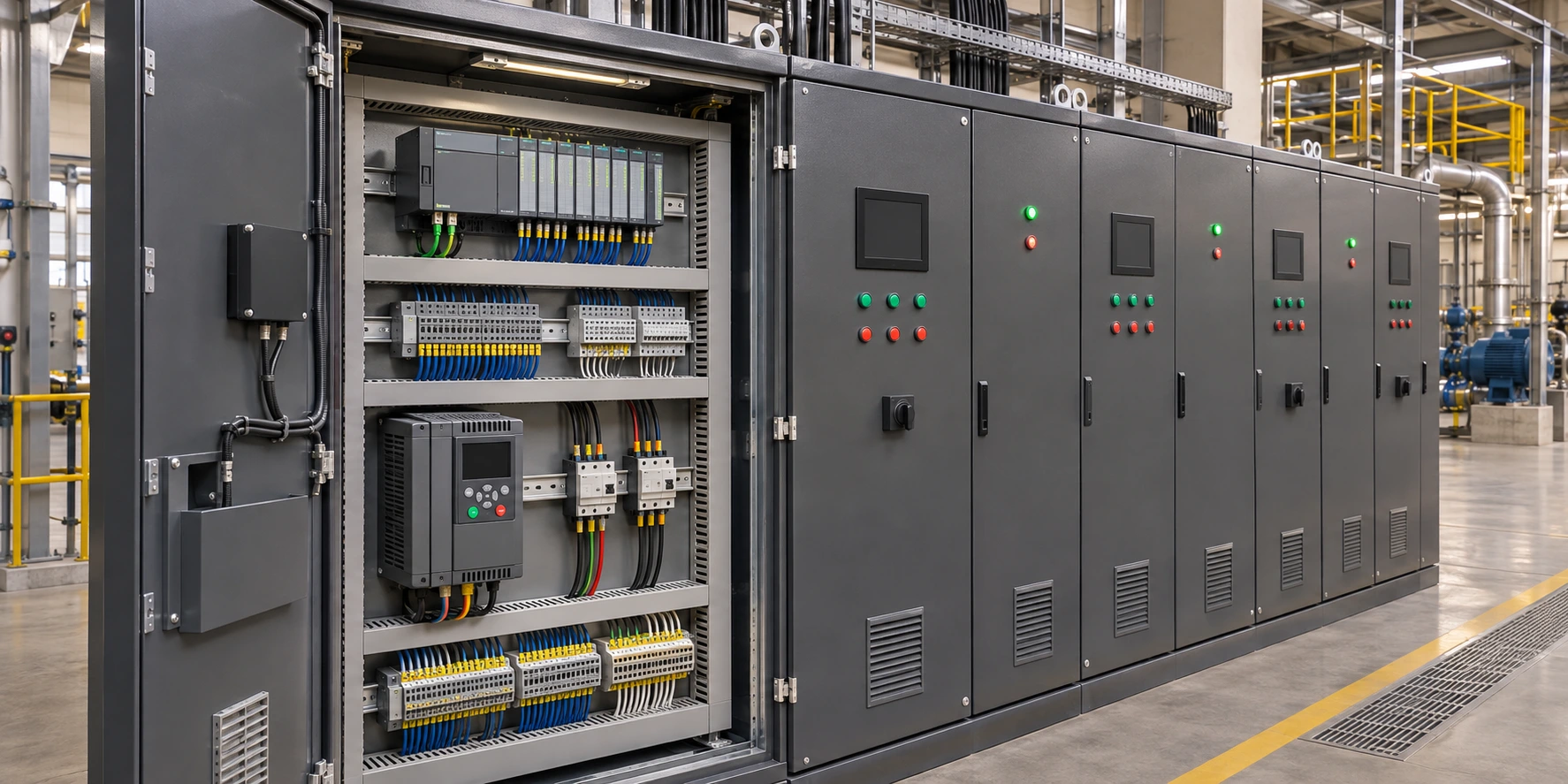
Most facilities use several types together. This guide explains ten common electrical and automation control panels, where they fit, and what to prepare before requesting a quote in Saudi Arabia.
10 Types of Electrical and Automation Control Panels
Quick answer
MDBs and SMDBs distribute power. MCCs, VFD panels and soft starter panels handle motor circuits. PLC and remote I/O panels support automation. ATS and synchronizing panels handle different standby-power functions. APFC panels correct power factor.
1. Main Distribution Board (MDB)
The MDB receives incoming low-voltage power and distributes it to downstream boards and major equipment. In a factory expansion, it might supply a new production area, an MCC for process motors, and a separate distribution board for building services.
Start with the single-line diagram and load schedule. These show which feeders the MDB needs to supply and help the project team check the incoming supply, available fault current, and capacity for future loads. If the project extends an existing installation, share the current board details and the proposed new loads together.
2. Sub-Main Distribution Board (SMDB)
An SMDB takes power from the main distribution system and distributes it within a specific area. In a hospital, it may serve a wing or group of floors. In a factory, it may serve a workshop, warehouse, or production area.
The load schedule should identify what the SMDB feeds today and any expansion already planned. The installation team should also know the available wall or floor space and whether cables enter from the top or bottom.
3. Motor Control Center (MCC)
An MCC brings several motor feeders and their control and protection equipment into one assembly. A plant with pumps, fans, and conveyors can use an MCC to organize those circuits in a central location. Depending on the application, an MCC can contain conventional starters, soft starters, or variable frequency drives.
Prepare a motor list before selecting an MCC. Record each motor’s rating, what it drives, how often it starts, and whether it needs adjustable speed. Two motors with the same power rating can have different control requirements if one runs a fixed-speed conveyor and the other regulates pump pressure.
4. Variable Frequency Drive (VFD) Panel
A VFD panel is used when a motor needs to change speed during operation. Think of a water pump that speeds up when demand rises, or a ventilation fan that slows down when the required airflow drops. A VFD can receive its speed reference from a PLC or another controller, depending on the system design.
Share the motor nameplate data, load type, expected speed range, and operating conditions. For a retrofit, include the existing drive model and how it communicates with the control system. Check enclosure and cooling requirements during panel selection.
View the ABB ACS880 industrial drive · Explore VFD installation and commissioning
5. Soft Starter Panel
A soft starter brings a motor up to operating speed gradually. It suits applications where the motor needs a controlled start and then runs at a fixed speed. A fixed-speed pump that starts several times a day is one example.
The choice between a soft starter and a VFD comes down to what happens after startup. If the motor needs to vary its speed while running, consider a VFD. If the main requirement is a gradual start, assess a soft starter against the motor data, load characteristics, and expected starts per hour.
View the Altistart 48 soft starter · Explore soft starter installation and configuration
6. Programmable Logic Controller (PLC) Panel
A PLC panel reads signals from field devices and runs the logic that controls equipment. It can start pumps in sequence, stop a conveyor when an interlock is active, or send an alarm to an operator screen. The MCC handles the motor circuits, while the PLC determines when the equipment should run.
Start with a written description of the process. List the sensors, valves, motors, and alarms, then explain what should happen in automatic mode, manual mode, and during a fault. Include any connection to a human-machine interface (HMI) or a supervisory control and data acquisition (SCADA) system.
View the Siemens SIMATIC S7-1200 PLC · Explore SCADA integration services
7. Remote I/O Panel
A remote input/output panel collects signals close to field equipment and exchanges them with the central controller over a network. At a water facility, one remote panel can collect signals from pumps and level sensors in a distant area while the main PLC stays in the control room.
Identify where devices are installed, how many signals each area has, and which network the existing PLC supports. Decide what the equipment should do if communication is interrupted. That behaviour belongs in the control specification and test plan.
8. Automatic Transfer Switch (ATS) Panel
An ATS transfers designated loads from their normal source to an available alternate source when the transfer conditions are met. In a hospital, for example, an ATS may serve loads identified in the approved standby-power design.
Identify both sources, the loads served, and the required transfer and return sequence. Include any status signals or alarms that need to reach the facility monitoring system.
9. Generator Synchronizing Panel
A generator synchronizing panel coordinates generators designed to operate in parallel. It manages the conditions for connecting a generator to a common bus and supports load sharing once the units are running together.
A site can use both synchronizing controls and an ATS. The synchronizing system coordinates generators that supply the common bus, while the ATS transfers the designated loads between available sources. Provide the generator count and ratings, the existing controllers, and how the generators are expected to share the load.
10. Automatic Power Factor Correction (APFC) Panel
An APFC panel switches capacitor stages in or out as electrical demand changes. Its job is to improve power factor by compensating for reactive demand. A factory with equipment that starts and stops throughout the day is one example of a site where demand can change during a shift.
Use measured power factor and load data when discussing an APFC panel. If the facility already has VFDs or other nonlinear loads, flag them for review because harmonics can affect capacitor bank selection.
See EMAN FTC’s power factor panel project · Browse power distribution products
How These Panels Work Together in a Pump Station
Consider an illustrative three-pump station where demand changes throughout the day. The MDB supplies the MCC, which houses the pump motor feeders and protection. A pressure sensor sends readings to the PLC. The PLC decides when another pump is needed, and a VFD adjusts the speed of a pump configured for variable operation.
Commissioning check
Agree on what the station should do if a pump trips or a pressure signal is lost. Confirm whether a standby pump should start automatically and how operators should see the alarm. Record these decisions in the test plan.
What to Check Before Specifying a Control Panel
- Electrical requirements. Share the supply voltage, load schedule, and available fault current where documented. For motor panels, include the nameplate data and how the equipment starts and operates.
- Site conditions. Identify indoor or outdoor installation, expected ambient temperature, dust or moisture exposure, cable entry, and space for maintenance. Evaluate ingress protection and cooling separately.
- Integration and expansion. List the equipment the panel must communicate with, the required signals, and any planned additional motors or feeders. For an existing facility, provide the current controller and drive models if available.
- Project specifications. Confirm required drawings and verification records. Check the relevant part of IEC 61439 for applicable low-voltage assemblies and IEC 60529 for enclosure ingress protection. IEC 61439 assembly selection guidance · IEC 60529 IP code
For an existing panel, assess repair, retrofit, and replacement. A failed component may be repairable. Obsolete controls, recurring faults, or unavailable spares can make a retrofit worth considering. If the site must stay operational, discuss the shutdown window and what can be tested before changeover.
Explore control panel troubleshooting and maintenance · Explore automation upgrades and retrofitting
Real Automation Projects by EMAN FTC
- Rowadh Water Supply Station, Riyadh. EMAN FTC upgraded the PLC system for the water supply station.
- Al Safwa Cement Company, Jeddah. EMAN FTC installed and commissioned ABB variable frequency drives.
- Sadara Chemical Company, Jubail. EMAN FTC installed and commissioned ABB variable frequency drives.
- Prince Abdullah Hospital. EMAN FTC programmed and commissioned an automatic transfer switch.
See completed automation projects · View MCC, VFD, MDB, and power factor panel photos
What to Include in a Control Panel Quote Request
Start with the project city and a short description of what the panel needs to do. If you have drawings, specifications, or equipment details, use the checklist below to decide which documents to share.
| Enquiry type | Details to share |
|---|---|
| MDB, SMDB, or ATS | Single-line diagram, supply details, load schedule, and source information where applicable |
| MCC, VFD, or soft starter | Motor list or nameplate data, equipment duty, and starting or speed-control requirements |
| PLC or remote I/O | Control sequence, I/O list, and details of existing equipment or networks |
| Upgrade or replacement | Existing drawings, panel or component model numbers, fault description, and the available shutdown window |
When comparing quotes, check which drawings, components, installation work, and testing each supplier includes. Agree on what should be demonstrated during factory acceptance testing (FAT) before delivery and what needs to be checked after installation during site acceptance testing (SAT), where required. For a pump panel, this could include pump sequencing, alarms, and the response to a simulated fault.
Frequently Asked Questions
What is the difference between an MCC and a PLC panel?
An MCC houses motor feeders and their control and protection equipment. A PLC panel runs the logic that tells those motors or other equipment when to operate. A project can use both.
Should I choose a VFD or a soft starter?
Consider a VFD when the motor needs adjustable speed during operation. Consider a soft starter when the main requirement is a gradual start followed by fixed-speed operation. Verify the choice against the motor data and load requirements.
Can I request a panel quote before the drawings are ready?
Yes. Share the project city, equipment or load details, and how the system should operate. The supplier can identify what additional information is needed to confirm the scope and pricing.
What affects the cost and lead time of an industrial control panel?
The panel rating, number of circuits or control points, enclosure, specified components, engineering work, and testing scope all affect the quote. For an upgrade, include access and shutdown requirements so suppliers can account for site work.
Request an Electrical or Automation Control Panel Quote
Planning a project in Riyadh, Dammam, Jubail, Jeddah, or elsewhere in Saudi Arabia? Tell EMAN FTC what equipment the panel needs to serve and how it should operate. Include any available drawings, load data, or motor details.