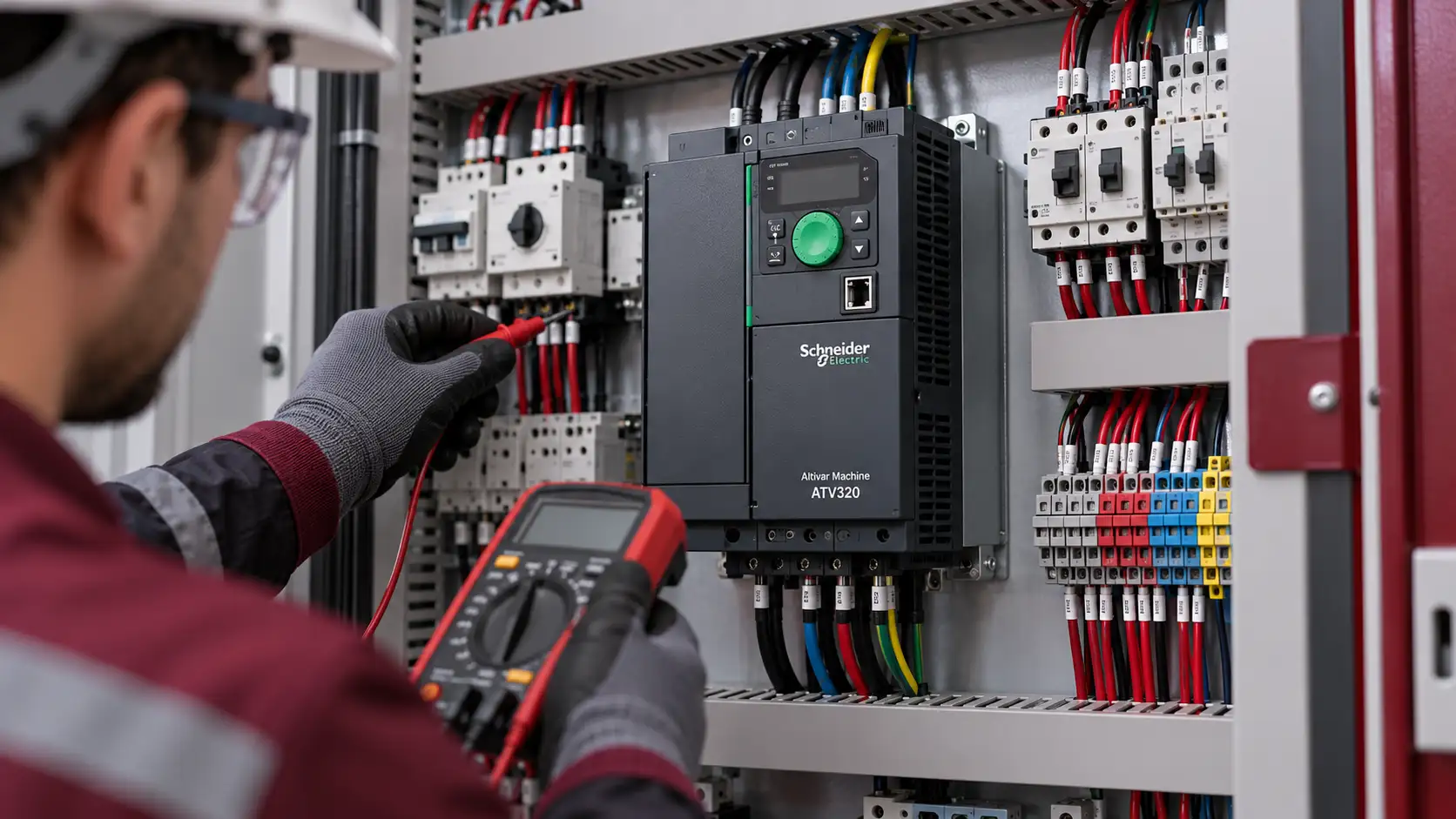
The Schneider ATV320 fault list helps technicians identify what the drive has detected. The code is only the starting point—the real cause may be the motor, electrical supply, wiring, mechanical load, communication network, cooling system, or drive configuration.
Before resetting an ATV320 or replacing the drive, note the displayed fault code and when the trip occurs. A fault during acceleration can point in a different direction from the same machine failing after several hours of operation.
This guide gives electrical engineers, maintenance teams, industrial companies, contractors, and machine operators a practical starting point for common ATV320 faults.
Schneider ATV320 Fault List – Quick Reference
Start with the displayed code, then inspect the related part of the system. Do not assume the VFD itself has failed.
| Fault Code | Meaning | Possible Cause | Check First |
|---|---|---|---|
| OCF | Overcurrent | Heavy load, motor issue, incorrect drive settings | Motor, mechanical load and motor parameters |
| OLF | Motor overload | Excessive motor current or mechanical load | Motor load and nameplate settings |
| OHF | Drive overtemperature | Restricted airflow, high temperature or cooling issue | Cooling fan, filters and panel ventilation |
| USF | Undervoltage | Low supply voltage or temporary voltage dip | Incoming electrical supply |
| OSF | Mains overvoltage | Excessive supply voltage or power-quality issue | Incoming supply voltage |
| PHF | Input phase loss | Missing phase or unstable incoming supply | Phases, breakers, fuses and terminals |
| OPF1 | One output phase loss | Motor cable or terminal connection problem | Drive-to-motor wiring |
| OPF2 | Output phases lost | Motor disconnected or output circuit problem | Motor wiring and output circuit |
| SCF1 | Motor short circuit | Motor or output cable short circuit | Motor cable, terminals and insulation |
| SOF | Overspeed | Load condition or incorrect speed-related settings | Motor, mechanical load and parameters |
ATV320 Overcurrent Fault – OCF
An OCF fault means the ATV320 has detected excessive motor current. Check whether the motor information entered into the drive matches the actual motor nameplate and inspect the driven machine for excessive mechanical load.
For recurring drive faults, see EMAN FTC's VFD Installation & Commissioning Services .
ATV320 Motor Overload Fault – OLF
An OLF fault points to a motor overload condition. Check the actual machine load together with rated motor current, voltage, frequency, and other motor data stored in the drive.
ATV320 Overtemperature Fault – OHF
An OHF fault indicates that the drive temperature is too high. Check cooling fans, filters, enclosure ventilation, ambient temperature, and motor loading.
If the ATV320 is installed inside a larger industrial panel, see our Control Panel Troubleshooting & Maintenance Services .
ATV320 Undervoltage and Overvoltage Faults
A USF fault points toward low incoming supply voltage or a temporary voltage dip. Measure the incoming supply and check whether the problem occurs during starting or heavy loading.
An OSF fault indicates an overvoltage condition. Check the supply and operating conditions before changing drive parameters.
EMAN FTC supplies circuit breakers, contactors, overload protection and motor protection equipment for industrial electrical systems.
ATV320 Input Phase Loss – PHF
A PHF fault directs attention to the incoming supply. Check whether all phases are present and inspect upstream breakers, fuses, terminals, and cable connections.
A loose connection can produce an intermittent phase problem, so a normal reading while the equipment is stopped does not always prove that the supply remains stable under load.
ATV320 Output Phase and Short-Circuit Faults
OPF1 indicates loss of one motor output phase. Start with the cable and terminal connections between the ATV320 and the motor.
OPF2 may appear when the motor is disconnected, an output contactor is open, or there is a problem in the motor output circuit.
For SCF-related faults, inspect the motor and output wiring for phase-to-phase or phase-to-ground problems. The motor terminals and insulation condition may also need testing.
For electrical measurements and insulation checks, explore EMAN FTC's Electrical Testing Equipment .
ATV320 Overspeed Fault – SOF
An SOF fault means the ATV320 has detected an overspeed condition. The cause may involve the mechanical load, motor setup, speed-control conditions, or a high-inertia application.
Check When the ATV320 Fault Occurs
The timing of the trip can provide an important clue during troubleshooting.
| When the Fault Appears | Areas to Investigate |
|---|---|
| Immediately after power-up | Supply, configuration, communication or internal drive condition |
| When START is commanded | Motor wiring, control signals, interlocks and motor parameters |
| During acceleration | Mechanical load, motor data, acceleration settings and current |
| During normal operation | Load, supply, motor condition, temperature and wiring |
| During deceleration | Load inertia, regenerative conditions and deceleration settings |
| After long operation | Cooling, panel temperature, ventilation and motor loading |
Do Not Troubleshoot the ATV320 in Isolation
Not every VFD problem starts inside the drive. A motor may refuse to start because of an active PLC interlock even when the ATV320 itself is healthy.
Communication problems can originate from the PLC, HMI, network cable, Modbus settings, communication modules, or control wiring. Repeated trips may also involve breakers, contactors, terminals, sensors, the motor, or supply voltage.
For faults involving several parts of the control system, see EMAN FTC's Control System Fault Analysis Services .
For command and interlock problems, see our PLC Troubleshooting & Maintenance Services .
For display or communication issues, see HMI Troubleshooting & Configuration Services and SCADA System Integration & Support .
When Should You Call a VFD Technician?
If the same ATV320 fault returns after the obvious external causes have been checked, avoid repeatedly resetting the drive.
Recurring overcurrent, short-circuit, overheating, voltage, communication, or internal faults should be investigated with the motor, wiring, control panel, and automation system considered together.
EMAN FTC provides VFD troubleshooting, parameter configuration, installation, integration, maintenance, and commissioning support for industrial applications in Saudi Arabia.
Frequently Asked Questions
What does OCF mean on a Schneider ATV320?
OCF indicates an overcurrent condition. Check the mechanical load, motor condition, motor data, wiring, and the operating condition when the trip occurs before replacing the drive.
Why does my ATV320 keep showing OLF?
OLF is associated with motor overload. Check the actual machine load and make sure the motor nameplate information entered into the drive matches the installed motor.
Can a motor or cable cause an ATV320 fault?
Yes. Motor insulation problems, loose terminals, damaged output cables, missing phases, or mechanical loading can create faults that appear on the VFD.
Should I reset the ATV320 every time it trips?
Not automatically. If the same fault keeps returning, identify the cause first. Repeated resetting can hide an electrical, mechanical, cooling, or configuration problem.
Can a PLC interlock stop an ATV320 from running?
Yes. A healthy VFD may remain stopped if the PLC, safety circuit, sensor, or process interlock is not allowing the run command.
Important: ATV320 fault handling can depend on the drive model, configuration, firmware, motor data, and installed options. Confirm critical troubleshooting and parameter changes against the Schneider Electric documentation for your exact ATV320 drive.
Need Help With a Schneider ATV320 Fault?
Send the fault code, ATV320 model, motor nameplate details, control-panel photos, site location, and a short explanation of when the problem occurs.
This information helps narrow the possible cause before troubleshooting begins.
Phone / WhatsApp:
+966 58 339 5756
Email:
info@emanftc.com
Website:
emanftc.com