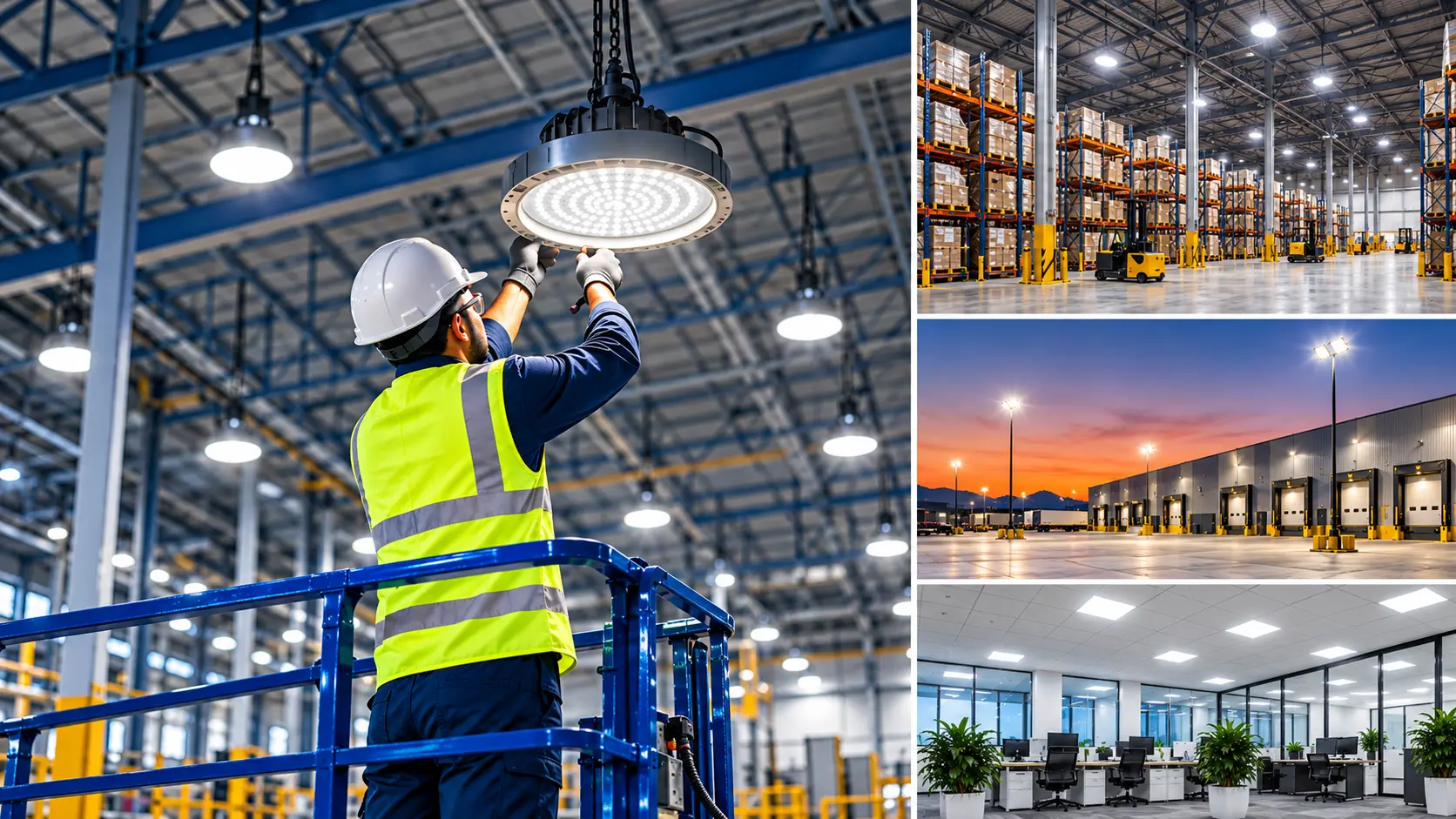
Quick answer: Choosing industrial LED high bay lights in Saudi Arabia depends on ceiling height, required lumen output, beam angle, and the environment's dust or heat exposure. A 10-meter warehouse typically needs narrower beam angles and higher lumen fixtures than a 6-meter space. Matching fixture specifications to the actual facility layout — not just wattage — determines lighting quality and long-term costs.
If you manage a warehouse, factory floor, or logistics facility in Saudi Arabia, you've probably asked: which LED high bay light fits your space? It's not a simple swap of old fixtures for new ones. Ceiling height, beam spread, dust levels, and even how your racks are arranged all affect which fixture performs well and which one leaves you with dark aisles or wasted energy.
This guide walks through the practical side of selecting industrial LED high bay lights for Saudi facilities — from Riyadh distribution centers to Jubail industrial plants. We'll cover how to choose the right specifications, what a 10-meter ceiling installation looks like, how LED compares to metal halide lighting, and what often goes wrong when businesses buy in a hurry.
What Are Industrial LED High Bay Lights?
Industrial LED high bay lights are fixtures designed for spaces with ceilings typically above 6 meters — think warehouses, manufacturing plants, distribution centers, and large workshops. They're built to throw light downward and outward across wide, open areas, unlike the lighting needs of a standard office or retail space.
Compared with older lighting technologies, LED high bay fixtures generally offer longer lifespans, more consistent light output, and better compatibility with dimming and control systems. But "better" doesn't mean "one size fits all." The right LED high bay light for a cold storage facility in Dammam looks different from the right fixture for a dry goods warehouse in Jeddah.
How to Choose the Right LED High Bay Lights for Your Warehouse
Picking a fixture isn't just about wattage on a spec sheet. Here's what actually determines whether your lighting setup works well in practice.
Ceiling Height and Mounting Position
Ceiling height is usually the first thing to establish, because it dictates both the lumen output you need and the beam angle that will distribute light effectively. A fixture mounted at 5 meters behaves very differently than the same fixture mounted at 12 meters — light that feels bright directly under the fixture can fall off sharply at the edges of the illuminated area if the height and beam angle aren't matched correctly.
Mounting position also matters for maintenance access. Fixtures over storage racks or conveyor lines need enough clearance for safe servicing, so factor that into your layout planning before installation.
Lumens vs. Watts — What Matters More?
Wattage tells you how much electricity a fixture draws. Lumens tell you how much visible light it actually produces. For industrial lighting decisions, lumens (and more specifically, lumens per square meter at the working plane) matter more than watts alone.
Two fixtures with the same wattage can produce very different amounts of usable light depending on their efficiency. When comparing LED high bay lights for factories or warehouses, ask for lumen output and efficacy (lumens per watt) rather than relying on wattage as a shorthand for brightness.
Beam Angle and Light Distribution
The beam angle of high bay lighting affects how light spreads across your floor space. Narrower beam angles (around 60–90 degrees) concentrate light into a tighter area, which works well for tall ceilings or narrow aisles between storage racks. Wider beam angles (120 degrees or more) spread light over a broader area, suiting open floor spaces with lower ceilings.
Using the wrong beam angle is one of the most common reasons a lighting upgrade doesn't deliver the expected improvement—you can have plenty of lumens and still end up with uneven light if the beam spread doesn't match the space.
IP Ratings and Dust Protection
Many Saudi industrial environments deal with dust, sand, and temperature swings, so it's worth checking ingress protection (IP) ratings carefully. IP65 LED high bay lights are sealed against dust ingress and low-pressure water jets, making them a common choice for workshops, warehouses near construction zones, or facilities exposed to airborne particulates.
If your facility has higher humidity or washdown requirements — such as food storage or certain manufacturing processes — you may need to look at higher IP ratings specific to those conditions. The right rating depends on your facility's actual exposure, not a general assumption about "industrial" environments.
Temperature and Heat Resistance
LED components are sensitive to heat buildup, and excessive heat can shorten a fixture's operational lifespan. Facilities with high ambient temperatures—common in parts of Saudi Arabia, especially during summer months—benefit from fixtures with effective heat-dissipation design, such as adequate heat sink sizing.
This detail is easy to overlook when comparing fixtures on price alone, but it directly affects how long your lighting investment lasts.
Fixture Spacing and Lighting Uniformity
Even with the right fixture, poor spacing can create uneven lighting—bright spots directly under each fixture and dim patches in between. Lighting uniformity depends on spacing relative to mounting height and beam angle, which is why warehouse lighting design typically involves a lighting layout calculation rather than simply distributing fixtures evenly across a floor plan.
LED High Bay Lighting for a 10-Meter-High Warehouse — Practical Example
The following is an illustrative scenario, not a documented project, intended to show how these selection factors come together in practice.
Picture a warehouse in Riyadh with a 10-meter ceiling height, storage racks along the perimeter, a central loading area, and several aisles between racking sections. The facility manager has noticed uneven lighting — bright near the loading dock, dim in the far aisles — and wants to replace the existing fixtures with LED high bay lights.
Here's how an engineer might approach it:
- Assess the working areas separately. Aisles, open floor space, and the loading dock each have different lighting needs, so they're evaluated individually rather than as one uniform space.
- Let ceiling height guide fixture selection. At 10 meters, fixtures generally need higher lumen output and a narrower beam angle than at 6 or 7 meters to maintain adequate brightness at floor level.
- Vary beam angles by zone. Narrow aisles between racks may call for a tighter beam angle to concentrate light downward, while the open loading area might use a wider beam angle to cover more floor space per fixture.
- Recognize that lumens alone don't determine fixture count. Two warehouses with identical lumen requirements per square meter can need different fixture quantities depending on layout, obstructions, and mounting height.
- Factor in layout and electrical compatibility. Existing wiring, available mounting points, and maintenance access (such as clearance for a scissor lift) all influence which fixtures are practical to install.
- Finalize with a lighting calculation and site assessment. The calculation, not a general rule of thumb, determines the actual number and placement of fixtures.
This process — assess, calculate, confirm — is standard for any serious warehouse lighting design project, regardless of city or facility type.
How Many LED High Bay Lights Does a Warehouse Need?
No fixed number applies to all warehouses, because fixture count depends on ceiling height, beam angle, desired light levels (measured in lux), and the space's physical layout. A 1,000-square-meter warehouse with a 6-meter ceiling will likely need a different fixture count and spacing than a 1,000-square-meter warehouse with a 10-meter ceiling, even if both require similar lux levels at the working plane.
The only reliable way to answer this for a specific facility is through a lighting layout calculation that accounts for the building's dimensions, ceiling height, fixture specifications, and the lux level required for the tasks performed in each zone.
LED High Bay Lights vs. Traditional Metal Halide Lighting
Many facility managers in Saudi Arabia are evaluating whether to replace existing metal halide high bay fixtures with LED alternatives. Here's how the two technologies generally compare:
| Factor | LED High Bay Lights | Metal Halide High Bay Lights |
|---|---|---|
| Energy consumption | Generally more efficient per lumen output | Generally less efficient per lumen output |
| Startup/restrike behavior | Instant-on, no warm-up or restrike delay | Requires warm-up time; hot restrike delay after power interruption |
| Maintenance requirements | Lower maintenance frequency due to longer lamp life | Higher maintenance frequency due to shorter lamp life and ballast replacement |
| Operational lifespan | Typically longer rated lifespan | Typically shorter rated lifespan |
| Light output and distribution | More consistent output over time; wide range of beam angle options | Output tends to degrade (lumen depreciation) over the lamp's life |
| Control compatibility | Generally compatible with dimming and automated control systems | Limited or no dimming compatibility in most configurations |
| Replacement considerations | Fixture and driver replacement if components fail | Bulb and ballast replacement as separate maintenance items |
These are general technology characteristics, not performance guarantees for any specific product or installation. Actual results depend on the fixture model, installation quality, and facility conditions.
How Much Do Industrial LED High Bay Lights Cost in Saudi Arabia?
Pricing for industrial LED high bay lights in Saudi Arabia varies based on fixture wattage, lumen output, IP rating, brand, and whether installation and electrical work are included. Facilities with more complex layouts, higher ceilings, or specialized requirements (such as explosion-proof fixtures for certain industrial zones) will generally see higher total project costs than straightforward warehouse installations.
Because pricing depends heavily on project specifics, the most accurate way to get a cost estimate is to request a quotation based on your facility's dimensions, ceiling height, existing electrical infrastructure, and lighting goals.
Common Mistakes When Buying LED High Bay Lights
A few recurring issues show up when businesses purchase high bay lighting without a proper assessment:
- Choosing fixtures based on wattage alone, without checking lumen output or efficacy, can leave spaces underlit despite high energy draw.
- Ignoring beam angle entirely, leading to bright spots directly under fixtures and dark zones in between.
- Skipping an IP rating check for dusty or high-humidity environments, which can shorten fixture lifespan or void warranties.
- Assuming a direct one-to-one fixture swap when replacing metal halide fixtures, without recalculating spacing and quantity for the new technology.
- Overlooking maintenance access during fixture placement, making future servicing more difficult and costly than necessary.
- Not accounting for ambient heat in fixture selection, which can affect long-term LED performance in hot industrial environments.
Avoiding these issues usually comes down to one step: getting a proper site assessment and lighting calculation before placing an order, rather than estimating quantities based on square footage alone.
Where Are Industrial LED High Bay Lights Used in Saudi Arabia?
Industrial LED high bay lighting is used across a range of facility types throughout the Kingdom, including:
- Warehouses and distribution centers in Riyadh, Jeddah, and Dammam
- Manufacturing plants and production facilities
- Logistics and storage hubs near ports and industrial zones, including areas around Jubail and Al Khobar
- Workshops and maintenance facilities for construction and MEP contractors
- Cold storage and food handling facilities requiring specific IP ratings
- Large retail and wholesale storage spaces
The common thread across these facility types is a need for consistent, reliable lighting across large floor areas with varying ceiling heights and environmental conditions.
Industrial LED High Bay Lighting Supply and Installation by EMAN FTC
EMAN FTC is a Saudi-based industrial lighting supplier and service provider offering Industrial LED High Bay Lights along with fixture selection support tailored to your facility's ceiling height, layout, and environmental conditions.
Beyond supplying fixtures, EMAN FTC also provides Lighting System Installation Services in Saudi Arabia, covering electrical connections, fixture mounting, testing, and retrofitting projects for facilities looking to replace existing metal halide or outdated LED systems.
Whether you're planning a new facility or upgrading existing lighting, working with a supplier who understands both the technical specifications and the installation side can help avoid the common mistakes outlined above.
Frequently Asked Questions About Industrial LED High Bay Lights
What wattage LED high bay light is suitable for a warehouse?
Suitable wattage depends on ceiling height, required lux levels, and fixture efficacy (lumens per watt), not a fixed number that applies to all warehouses. The most reliable way to determine appropriate wattage is a proper lighting calculation based on your facility's dimensions and ceiling height.
What type of high bay lighting works best for a 10-meter ceiling?
For a 10-meter ceiling, you generally need fixtures with higher lumen output and a narrower beam angle to maintain adequate brightness at floor level than in lower-ceiling spaces. The exact specification should come from a site assessment rather than a general assumption.
How many LED high bay lights does my warehouse need?
Fixture count depends on ceiling height, beam angle, desired lux level, and floor layout. There's no universal number — a lighting layout calculation specific to your facility's dimensions is needed for an accurate answer.
Are IP65 high bay lights suitable for dusty industrial areas?
IP65-rated LED high bay lights are sealed against dust ingress, making them a common choice for dusty industrial environments such as warehouses and workshops. Facilities with additional exposure, such as washdown requirements, may need to consider higher-rated fixtures.
Can metal halide high bay lights be replaced with LEDs?
Yes, you can generally replace metal halide fixtures with LED high bay lights, but a direct one-to-one swap isn't always appropriate. You typically need to recalculate spacing, beam angle, and fixture quantity to match LED technology's light distribution.
How much does industrial high bay lighting installation cost in Saudi Arabia?
Installation costs vary based on fixture specifications, facility layout, existing electrical infrastructure, and project complexity. The most accurate way to get pricing is to request a quotation based on your specific facility details.
What information do you need to request an industrial lighting quotation?
A quotation request should typically include ceiling height, facility dimensions, existing lighting equipment (if any), the type of space (warehouse, factory, workshop, etc.), and any specific environmental conditions such as dust, humidity, or temperature extremes.
Get the Right LED High Bay Lighting for Your Facility
Choosing industrial LED high bay lights in Saudi Arabia comes down to understanding your specific facility—ceiling height, layout, environmental exposure, and how the space is used day to day. Skipping that assessment is usually what leads to uneven lighting or an installation that doesn't perform as expected.
If you're planning a lighting upgrade or new installation, share your warehouse or facility dimensions, ceiling height, existing equipment details, and project requirements with EMAN FTC for a tailored quotation. Getting the specifications right from the start can mean the difference between a lighting setup that works and one you have to revisit a year later.
WhatsApp: +966 58 339 5756 | Email: info@emanftc.com