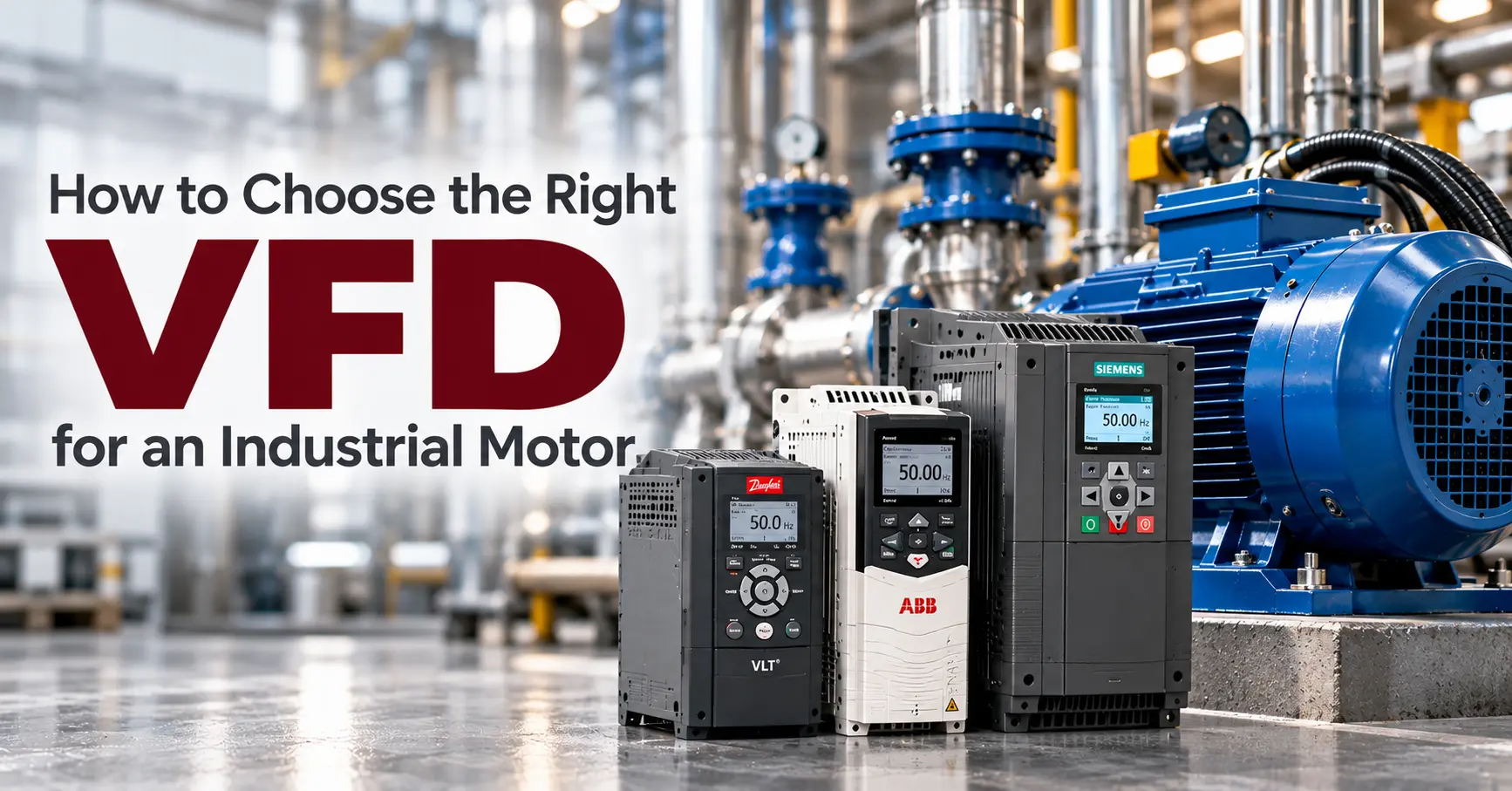
Choosing the correct Variable Frequency Drive (VFD) is critical for reliable motor operation, energy efficiency, and process control. If a drive is too small, it may overheat or trip. A VFD that is not properly selected may also fail to perform correctly with the motor or application.
Motor rating, voltage, current, load type, operating environment, and control requirements should all be considered when selecting the right VFD for an industrial motor.
1. Inspect the Motor Nameplate
Start by reviewing the motor nameplate. It provides the main electrical and operating information required for VFD selection.
| Motor Detail | Why It Matters |
|---|---|
| Motor Power | Helps determine the required VFD size |
| Rated Voltage | Should be compatible with the VFD output voltage |
| Rated Current | One of the most important parameters for VFD sizing |
| Frequency | Usually 50 Hz or 60 Hz depending on the motor |
| Motor Speed | Helps confirm application and operating requirements |
| Phase | Helps determine compatible VFD input and output requirements |
The VFD should be selected according to the electrical ratings of the motor and the operating conditions of the application.
2. Choose the Appropriate VFD Current Rating
Do not select a VFD based only on motor kW or horsepower. The VFD's rated output current should be equal to or greater than the motor's full-load current.
Applications with high starting torque or heavy loads may require additional overload capacity. The motor current and load profile should therefore be checked carefully before selecting the drive.
3. Consider the Load Type
Different industrial applications place different demands on the motor and VFD. Selecting the correct drive depends heavily on the type of load being controlled.
| Application | Typical Requirement |
|---|---|
| Pumps | Variable flow and smooth acceleration |
| Fans | Adjustable speed and energy control |
| Conveyors | Variable speed and controlled starting torque |
| Compressors | Stable and controlled motor operation |
| Mixers | Higher torque across different operating speeds |
| Process Equipment | Accurate speed control and automation integration |
Heavy-duty applications may require a VFD with a higher overload rating than standard variable-torque applications.
4. Check the Power Supply
The available electrical supply should be compatible with the selected VFD.
- Input voltage
- Number of phases
- Supply frequency
- Available electrical capacity
- Protection requirements
The drive must also be compatible with the motor voltage and the site's electrical system.
5. Consider the Operating Environment
Environmental conditions can affect VFD performance, reliability, and service life.
- Ambient temperature
- Dust levels
- Humidity
- Ventilation
- Control-panel cooling
- Installation altitude
In Saudi Arabia, high temperatures and dusty industrial environments can make proper ventilation, cooling, and control-panel protection particularly important.
6. Define the Required Control Features
A VFD may need to communicate with other industrial automation equipment. Communication and control requirements should therefore be confirmed before selecting the drive.
- PLC control
- HMI monitoring
- SCADA integration
- Analog speed reference
- Digital inputs and outputs
- Ethernet or Modbus communication
- Alarm and fault monitoring
For integrated automation systems, make sure the VFD supports the required communication protocol and control method.
7. Choosing the Right VFD for Your Application
The largest or most expensive VFD is not necessarily the best choice. The correct drive should match the motor, load, control system, electrical supply, and site conditions.
Before installation, verify the motor data, load characteristics, power supply, communication requirements, and environmental conditions.
VFD Support in Saudi Arabia
EMAN FTC provides VFD and industrial automation support across Saudi Arabia, including installation, commissioning, troubleshooting, and control-system integration.
Related Services
- VFD Installation & Commissioning Services
- Industrial Automation & Control Services
- PLC Troubleshooting & Maintenance Services
- HMI Troubleshooting & Configuration Services
- SCADA System Integration & Support
For problems with an existing drive, read our VFD Troubleshooting Guide .
You can also compare different motor-control options in our VFD vs Soft Starter Guide .